Magazine and pick-off
Separates flat printed cartons and transfers each blank without double-feeding.

Carton handling must be matched to the packaging material. Folding cartons for individual bottles are different from corrugated transit boxes, and machinery descriptions should not blur that distinction.
Separates flat printed cartons and transfers each blank without double-feeding.
Opens the blank squarely and holds it stable for product loading.
Folds and inserts designed tabs without tearing board or damaging print.
Applies and compresses glue flaps under controlled time, temperature and pressure conditions.
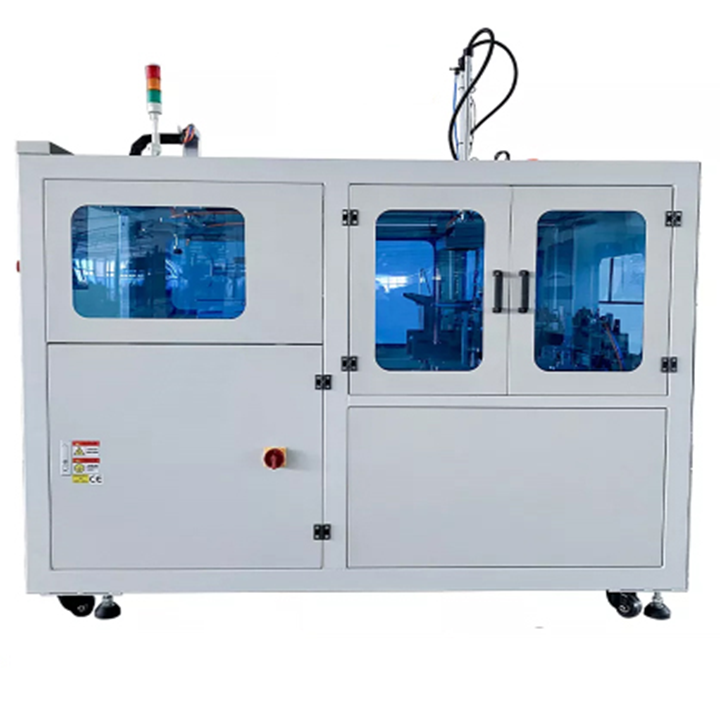
For larger corrugated transit boxes, an LUBFM2-style carton former performs a different job: it feeds flat pre-scored sheets, folds and staples the case, then discharges the formed box. It does not load bottles into printed folding cartons.
Published application data lists a typical capacity of 600–800 cartons per hour, subject to carton size and material. The stated configuration uses a PLC touchscreen, pneumatic actuation and an integrated discharge conveyor.
Ask about carton forming| Working capacity | 600–800 pieces per hour, size dependent |
|---|---|
| Voltage / power | 220 V, 60 Hz / 3.5 kW |
| Air pressure | 0.6–0.8 MPa |
| Air consumption | Approximately 450 NL/min |
| Carton material | Single-layer corrugated, at least 2 mm |
| Machine dimensions | Approximately 2200 × 2200 × 2000 mm |
| Machine weight | Approximately 780 kg |
Reference data is application-dependent and should be reconfirmed against the current quotation and approved samples.
No. A carton former creates or erects an empty carton. A bottle cartoner also controls and loads the bottle or bottle group before the carton is closed.
Usually these materials require different handling principles, tooling and closure systems. The intended board construction should be fixed during specification.
Send your bottle, carton, output and layout details. We will review the application and identify the machine format and integration questions that matter.
“Carton forming” can describe different packaging processes. A bottle cartoner normally handles printed folding-carton blanks, erects them, loads the product and closes tuck or glue flaps. A corrugated case former handles a heavier shipping case or scored corrugated sheet and may discharge an empty case for a separate packing stage. These applications use different materials, forming forces, tooling and acceptance criteria.
For folding cartons, provide the approved dieline and control the board grade, caliper, grain direction, coatings, crease geometry and glue areas. Magazine performance depends on how flat blanks are cut, packed and stored as well as their nominal dimensions. The carton should open squarely, remain supported during loading and reach the closing station with flaps in a predictable position.
| Method | Points to verify with the intended carton |
|---|---|
| Tuck closure | Flap geometry, crease recovery, locking engagement, board marking, opening force and whether the product obstructs the closing path. |
| Hot-melt glue | Approved adhesive, application position, open time, compression time, coating compatibility, stringing control and safe access for cleaning. |
| Lock or specialist closure | Sequence of folds, tooling access, repeatability, inspection method and how a partially engaged closure is separated from acceptable production. |
| Corrugated forming | Board construction, score pattern, forming method, fastening method, empty-case squareness and the interface to the separate loading or packing stage. |
Closing quality should be expressed as an observable pack standard. For glue, do not rely only on the presence of a glue command; define how application and final bond quality are checked. For tuck closures, describe correct engagement and carton shape. In either case, the machine response to an unclosed or damaged pack should be agreed with the reject strategy.
The numerical LUBFM2 reference data already shown on this page relates to a corrugated forming application. The specialist model page is owned by Packaging Machines UK; bottle-loading folding-carton projects should instead be defined through the automatic cartoner and specification pages. This separation avoids comparing unlike equipment.
Include samples from the intended converter, the board specification, closure method, print-critical surfaces and the finished-pack standard. This allows magazine, erection and closing risks to be considered together.
Caliper affects magazine separation, vacuum pick-off, crease behaviour, internal fit and flap closing. The machine should be tested with the approved range rather than only one ideal sample.
No general assumption should be made. Adhesive, coating, glue pattern, compression and operating conditions need to be reviewed together and proven with the intended board and approved adhesive.
The method depends on the closure. It may include flap position, glue application monitoring, code or vision checks and a downstream pack-quality check. Detection, reject action and reject confirmation should be considered as one function.
Not necessarily. A former may create and discharge an empty corrugated case for a separate packing operation. Confirm whether product loading, partitions, closing and discharge are included rather than relying on the word “cartoner”.
A folding-carton drawing confirms geometry, but it does not prove that production blanks will separate, open squarely and close consistently. Board caliper, grain direction, moisture, coating, print finish, crease quality, curl and packing orientation can change machine behaviour. A capability trial should therefore use blanks from the intended converter and include the accepted production variation rather than one hand-selected sample.
| Symptom | Possible areas to examine | Evidence to retain |
|---|---|---|
| Blank fails to separate | Surface finish, static, curl, magazine pressure, blank packing direction, suction contact and contamination at the pick point. | Converter batch, blank revision, storage condition, rejected sample and machine setting used during the trial. |
| Carton does not open squarely | Dieline geometry, crease definition, grain, pre-break requirement, vacuum timing and support during transfer to the loading station. | Photographs or retained examples showing the opening fault and the condition of each crease. |
| Tuck flap does not engage | Flap geometry, board spring-back, product obstruction, guide alignment, closing sequence and the fit between locking features. | Approved finished-carton standard, affected blank and the product position at the time of the fault. |
| Glue closure is weak or untidy | Approved adhesive, application pattern, substrate/coating compatibility, equipment condition, compression and contamination. Operating settings must be confirmed for the selected glue system rather than assumed. | Glue specification, application record, retained sample and agreed method for assessing closure quality. |
| Finished carton is bowed or marked | Internal product fit, closing force, support surfaces, board stiffness, print protection and the time available for the closure to stabilise. | Accepted and rejected packs compared against a written presentation and functional standard. |
The approved blank should be identified by dieline revision, converter, board description, print/coating construction and closure method. A later change that appears minor on artwork can still affect pick-off, opening or closing. Establish who reviews a changed blank, what samples are needed and whether the change can be accepted through inspection, a targeted trial or a formal format revalidation.
This page is centred on folding cartons that receive bottles or bottle groups. A machine that forms an outer corrugated case has a different material path and product-loading boundary; the existing corrugated carton-former page remains the owner of that model intent. Filled transit-case taping is covered separately by case taping machinery.
Use the automatic cartoner page to connect blank handling with product loading and inspection, and the specification checklist to record the approved material and acceptance sample.
Include the dieline, board description, coating, closure method, product sample and examples of the finished-pack standard. This gives the forming and closing review a controlled material basis.
Carton erection and closing are linked through the blank design, board behaviour, panel geometry and support available while the flaps are manipulated. A closure that works by hand may not provide the same tolerance or sequence when the carton is moving through an automatic machine.
Prepare production-intent blanks and record grain direction, coating, joint and revision status before tooling approval.
Closure selectionDefine opening behaviour, tamper expectation, coated areas, glue-free zones and the accepted finished-carton condition.
Acceptance evidenceInclude double picks, poor opening, damaged flaps, incomplete tuck, glue faults and restart conditions in the test plan.
Supply the approved flat blank, assembled carton and dieline together. Mark which dimensions and material features are controlled by the carton supplier and which remain provisional. Where the machine only forms or closes corrugated cases rather than loading folding cartons, keep that process boundary explicit so the equipment is not compared on an incorrect basis.
Representative blanks expose material and geometry risks that drawings alone cannot show.
Send the approved dieline, board specification, production blanks and finished-pack standard with your enquiry.
Carton feed and closure reliability depend on the flat blank, the magazine and the closing method being specified as one material-handling system.
A carton magazine presents a controlled stack of flat blanks to a pick-off system that separates the leading blank, supports the remaining stack and transfers the selected blank into the erection sequence.
Vacuum, mechanical separation, stack pressure, blank angle and edge condition must work together. The machine cannot compensate indefinitely for blocked, curled or inconsistent blanks. The magazine should be tested with production-intent bundles and the replenishment method expected on site.
Read the detailed carton magazine and blank-feeding guide.
Double picks or missed picks can be caused by blank blocking, static, curl, coating variation, damaged edges, incorrect stack pressure, vacuum loss, worn suction components, poor separation or a magazine setting that does not match the batch.
Fault finding should separate material evidence from machine evidence. Record the blank batch, position in the bundle, vacuum response, pick timing and whether the fault follows a particular stack. Repeated adjustment without this evidence can hide the real source of variation.
The troubleshooting guide provides a controlled evidence sequence.
Crease condition and pre-break determine how readily a panel or flap folds along the intended line and how much spring-back the closing tool must control.
An under-developed crease can resist folding, while a damaged or over-worked crease can crack, distort or lose presentation quality. The machine setup should be based on production blanks representing the approved board, coating and converter tooling. Hand-folding one sample does not prove automatic repeatability.
Use the carton-blank design guide with the intended converter.
A carton is held square by coordinated support from the erection tooling, carton pocket or chain, flap guides and closing stations so that panels remain aligned while the product and closure forces are applied.
If the blank is twisted, the manufacturer’s joint intrudes, or the carton is released before it is stable, loading clearances and flap positions can change. The accepted squareness should be observable and linked to the finished-pack standard rather than judged only by whether the carton leaves the machine.
The blank-feeding guide explains how squareness is established upstream.
The converter agreement should identify the approved dieline, board construction and caliper range, grain direction, crease tooling, manufacturer’s joint, coatings, glue-free areas, print orientation, packing method and revision-control process.
It should also define how out-of-tolerance or damaged blanks are identified and how a material change is communicated before production. Machine trials are most useful when the converter supplies representative batches rather than selected development samples.
Record converter data in the cartoning specification checklist.
Send the approved dieline, board specification, printed flat blanks and finished-pack acceptance standard so the forming and closing sequence can be reviewed.
Straight tuck end and reverse tuck end cartons are not interchangeable names for the same closing sequence. The direction of the top and bottom flaps affects blank orientation, closing-tool approach and the format record used by the machine.
The new straight versus reverse tuck guide explains the closure directions, machineability review and sample evidence required before a carton style is approved.